
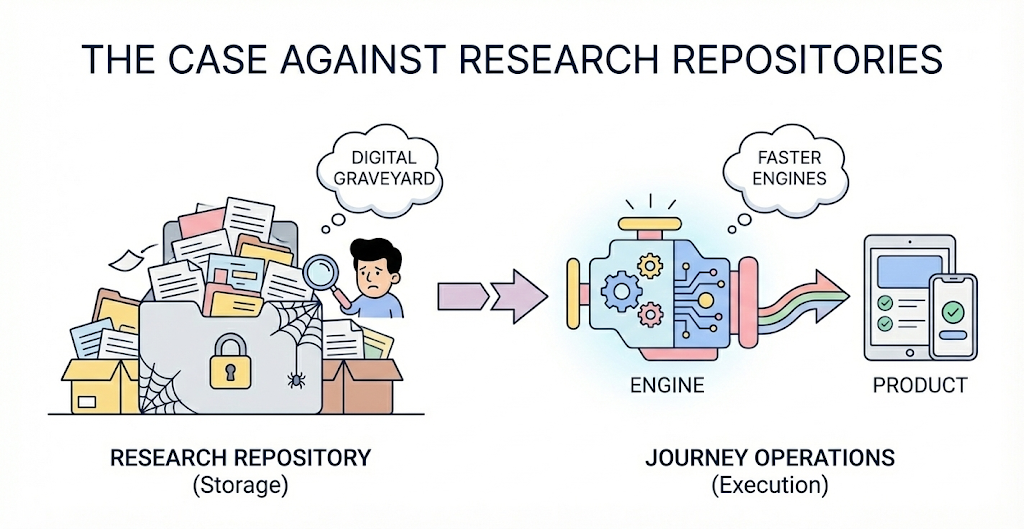
For the last decade, Design Operations has focused on a single problem: Storage.
Organizations have spent millions on "Research Repositories"—centralized libraries designed to tag, file, and index every interview, survey, and sticky note. The promise was that once we organized our knowledge, we would make better decisions.
The reality is different. In most organizations, the Research Repository has become a digital graveyard. Insights go in, but they rarely come out.
The "Librarian" Fallacy
The repository model assumes that product teams—Engineers, PMs, and Designers—have the time to browse a library. It assumes they will search for "user onboarding insights Q3," read a PDF, and then manually translate that into a Jira ticket.
They don't.
Product teams operate in linear workflows (Backlog → Design → Code). Anything that exists outside this stream is ignored. If research lives in a separate tool, requiring a separate login and a manual search, it effectively doesn't exist.
From Storage to Execution
The problem isn't that we lack data. The problem is latency.
The time it takes for a user insight to become an engineering specification is too long. In the current model, this "translation layer" is entirely manual:
- Researcher conducts interview.
- Researcher tags video.
- Researcher writes report.
- PM reads report.
- PM writes ticket.
- Engineer reads ticket.
This game of telephone creates drift. By the time the code is written, the original user context is lost.
The Design Engine
We need a different model. Call it Journey Operations.
Instead of treating the journey map as a static deliverable—a PDF to be filed away—treat it as the source of truth for the build. A "Pain Point" on a map shouldn't be a sticky note. It should be a data object directly linked to a spec. When the research updates, the spec updates. When the feature ships, the map reflects the new state.
There is no "report" to write. The map is the documentation. The research is the ticket.
Stop Managing, Start Building
The era of the "Design Librarian" is ending. The volume of data we generate is too high to be manually curated.
The future belongs to teams that can translate insight into execution in real-time. We don't need better filing cabinets. We need faster engines.
Don't Just Write Code. Define Intent.
Turn user friction into structured Intent Specs that drive your AI agents.
Get Started for Free