Every feature should trace back
to a real user problem.
Most teams build from opinions. Pathmode builds from evidence. We believe structured intent — grounded in real user friction — is the missing layer between discovery and execution.
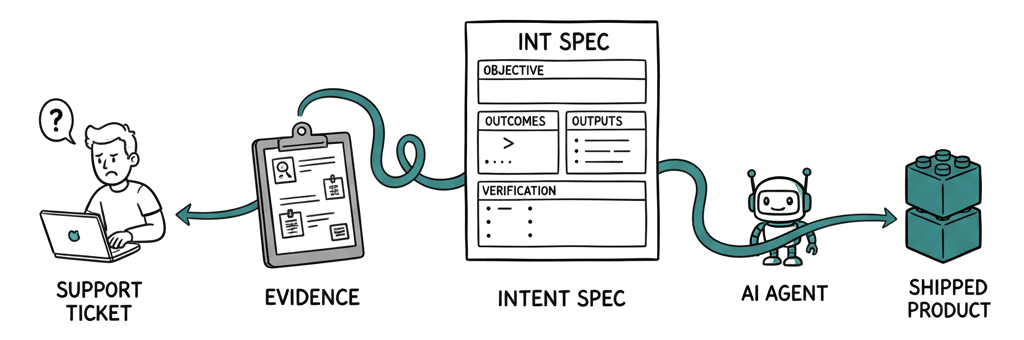
The full chain, from support ticket to deployed code, is traceable. And it runs both ways: when the build contradicts the spec, the finding flows back to refine it.
Intent is judgment under evidence —
not a contract you compile.
Intent Engineering is the discipline of deciding what to build, for whom, and on what evidence — in a form both humans and AI agents can execute against. Where prompt engineering shapes a single model interaction, intent engineering shapes the spec that survives across teams, sprints, and tools. Pathmode is the product judgment layer where this work happens.
Evidence over opinions.
Roadmaps should be grounded in real user friction — support tickets, research transcripts, analytics — not stakeholder guesses or competitor mimicry.
Specs capture judgment, not just contracts.
AI synthesizes structured intent from clustered evidence. Humans review and refine. The spec captures preconditions, edge cases, and success criteria — each traced to source. The point is not a static contract to compile against; it is the judgment you have earned from evidence, in a form an agent can execute.
Every shipped feature is auditable.
From the original support ticket to the deployed code, the chain is unbroken. Every outcome links to an intent. Every intent links to evidence. No black boxes.
Evidence, not artifacts.
Support tickets, research transcripts, analytics events, app reviews — these aren't artifacts to archive. They're evidence to synthesize. Pathmode ingests friction from your existing tools and organizes it by type: friction, quotes, observations, metrics, and requests.
Settings page: 73% drop-off rate before completing changes
"I can't find where to change my password — 5 minutes looking"
Average time-to-complete for settings: 4.2 min (target: <1 min)
6/8 usability test participants struggled to locate preferences
"Just let me see my account info without logging in every time"
Vision first, always.
Everything starts with your product vision. It defines the context — non-negotiables, tradeoffs, what matters. Every signal that flows in from users is checked against it. Aligned evidence becomes intent. Noise gets filtered out. Your vision is the gravity that keeps every decision in orbit.
"Make account management effortless — any change in under 60 seconds."
Guardrails, not guidelines.
Before a single spec is written, define the rules of the game. Your product vision, the tradeoffs you've made, and the non-negotiables no agent can break. Every rule flows automatically into intent specs and agent prompts — so AI knows your constraints before writing a single line of code.
"What should your product never compromise on — even under deadline pressure?"
"Customer data must never leak between tenants. Every destructive action must be reversible."
Specs are evidence-anchored judgment.
Users don't write specs — they review them. Pathmode synthesizes structured intent from your clustered evidence: objective, outcomes, edge cases, constraints. And evidence isn't only what users tell you — it's also what your code already does: Pathmode reads the connected codebase as the spec forms, so intent answers to what exists, not to assumption. Every field traces to a source — so when an AI agent asks "why," the answer is always there.
Redesign account settings to reduce drop-off and friction
From spec to shipped code.
Export structured intent directly to AI coding agents, GitHub Issues, Linear, or Jira. Every exported prompt includes your constitution rules as non-negotiable constraints. With GitHub connected, approved specs become delivery issues and merged PRs mark intent as shipped, so every agent action traces back to a spec and every spec traces back to evidence.
See the GitHub delivery loop
Intent Spec → GitHub Issue → PR merge → shipped status
Discovery doesn't end at ship.
Shipping isn't the end of the chain, it's the start of the next one. Two loops keep the spec alive. The tight one runs during the build: when an agent's work contradicts the spec, it writes back a finding, what the spec assumed versus what the build revealed, that rides into the next agent's prompt so the spec converges instead of repeating a dead premise. The slower one runs after release: every feature changes how users behave and what your code does, and that becomes new evidence. Pathmode is built for the cycle, not the line.
The cycle restarts, now with new evidence: the code you just shipped, and the findings the build wrote back.