
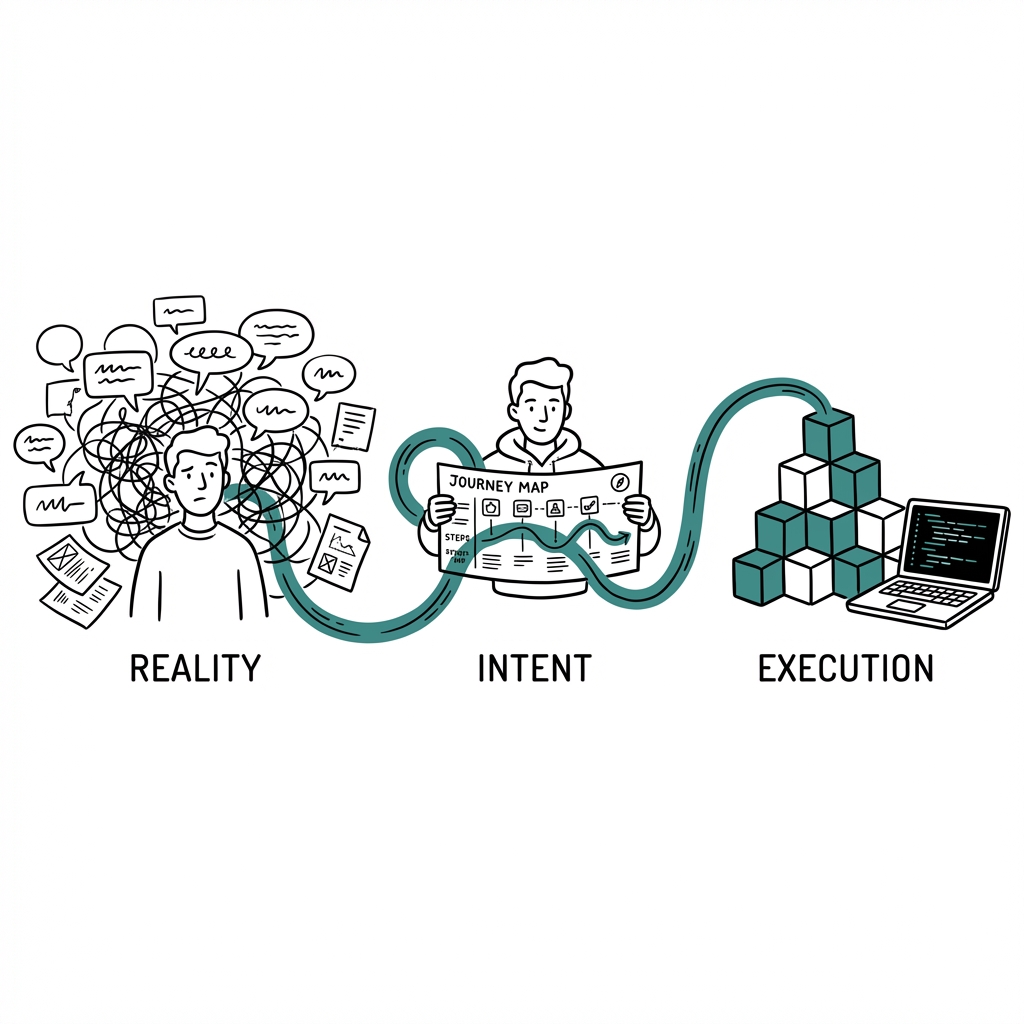
The future isn't Journey Management. It's Journey Execution.
The industry is waking up to this. Forrester predicts that 15% of CX teams will disappear this year and two-thirds will abandon journey mapping entirely. The diagnosis is accurate: teams are drowning in metrics. They are "measurement-obsessed," producing dashboards that report on the decline rather than fixing it.
But the proposed solution—"Journey Management"—is a half-measure. It's optimizing the layover instead of the flight.
The "Management" Trap
The current best practice says we need to move from "static maps" (PDFs on a wall) to "living maps" (dynamic software). The promise is that if we just manage the journey better—connecting insights to Jira tickets, syncing data across dashboards—we will survive.
I think this misses the point.
"Journey Management" is basically "better filing cabinets" for the digital age. Even a "living" map is fundamentally passive. It relies on humans to read it, interpret it, haggle over it in meetings, and then manually translate it into work items in another system.
It institutionalizes the bottleneck. It doesn't remove it.
The Shift: From Pictures to Payloads
In an AI-native world, we don't need to manage the gap between insight and execution. We need to close it entirely.
The Journey Map shouldn't be a dashboard for stakeholders. It should be the executable specification for the agents actually building the product.
Today, a Journey Map is a picture of pain. It shows a red precipice where customers drop off. A human looks at it, writes a ticket, assigns it, and waits.
Tomorrow, the Journey Map is an input:
- The Stage defines the context (where is the user in their workflow?).
- The Friction defines the problem (what is blocking them?).
- The Goal defines the success criteria (what does "fixed" look like?).
When you have these three things structured correctly, you don't need to write a ticket. You have an agent-ready contract. An executable spec that an AI can pick up and run.
This is the shift from Journey Management (organizing the backlog) to Journey Execution (compiling the map into shipped code).
What This Looks Like in Practice
Last week, a support ticket came in: "I can't find where to update my payment method."
In the old model, that ticket sits in a queue. Eventually, a PM reads it, writes a story, a designer mocks it, and an engineer ships it. Weeks pass.
In Journey Execution, that friction signal is placed on a Journey Stage. The system recognizes the pattern (47 similar signals at this step). It synthesizes an Intent Spec: clear problem, clear context, clear success criteria. An agent generates a fix. A human reviews and ships.
Time-to-Fix: hours, not weeks. That's the difference.
Administrating the Decline
If your journey map can't talk to your codebase, it's just wallpaper.
The teams that survive the "Death Spiral" won't be the ones with the prettiest dashboards. They will be the ones with the fastest Time-to-Fix.
They will treat customer friction not as a metric to be reported, but as raw material to be ingested, processed, and shipped.
| Approach | What It Looks Like |
|---|---|
| Metric Obsession | "Our NPS dropped 2 points." |
| Journey Management | "I've linked the NPS drop to this Jira epic." |
| Journey Execution | "The agent recognized the pattern, generated a fix, and it's in review." |
The future isn't about managing the journey. It's about compiling it.
If you can't compile the map, you're just watching the decline in higher resolution.
Don't Just Write Code. Define Intent.
Turn user friction into structured Intent Specs that drive your AI agents.
Get Started for Free