
There's a phrase that shows up in every job description for product teams:
"Collaborate cross-functionally with design, engineering, and product."
The assumption behind that sentence is that these are lanes. You're in one. Your job is to produce your specific artifact—a spec, a mockup, a pull request—then hand it over the wall to someone in a different lane.
This model made sense for decades. It doesn't anymore.
Not because cross-functional collaboration is bad. But because the reason we organized into lanes in the first place—that implementation was expensive and required deep specialization—is evaporating. And when the organizing constraint disappears, the org chart it produced starts to crack.
The Relay Race
The traditional software team is a relay race with four legs:
- PM writes the spec. Hands it off.
- Designer makes the mockups. Hands them off.
- Engineer writes the code. Hands it off.
- QA verifies it works.
Each role is defined by its artifact. The PM produces documents. The designer produces pixels. The engineer produces logic. Success is measured by whether you finished your artifact and handed it to the next person cleanly.
We organized this way because implementation was the bottleneck. Turning a mockup into working code took weeks of specialized labor. So we optimized the pipeline that fed the bottleneck: alignment meetings to reduce ambiguity, design systems to speed up translation, sprint planning to coordinate handoffs.
The entire ritual of modern product development—the standups, the grooming sessions, the "let me walk you through the Figma"—exists to service the handoff. It's infrastructure for moving information between specialists who each own one leg of the relay.
Why the Relay Race Is Ending
Two things are happening simultaneously.
First, the middle is disappearing. AI agents can take structured intent and produce working code. The implementation step—the one that justified the entire relay—is no longer the bottleneck. When a designer can describe an interaction in natural language and an agent produces a working Next.js implementation with auth and animations in under an hour, the relay has no third leg. There is no one to hand off to.
Second, the handoff itself is becoming the biggest source of failure. Every handoff is a lossy compression. The PM compresses customer insight into a spec. The designer compresses the spec into a mockup. The engineer compresses the mockup into code. At each stage, context is lost—and nobody notices until the feature ships and doesn't move the metric.
We've been tolerating this loss because the alternative—having one person do everything—was impossible. Nobody could design, specify, and implement at production quality.
That constraint is gone. The person who understands the problem can now ship the solution. The question is: what happens to the roles that were organized around a relay race that no longer runs?
The Builder
They don't disappear. They converge.
When AI handles implementation, everyone on the team gains the ability to ship. A designer can go from concept to working code. A PM can go from customer insight to deployed feature. An engineer can focus on system architecture while agents handle the application logic.
The output is the same for everyone: working software. What differs is the judgment they bring to it.
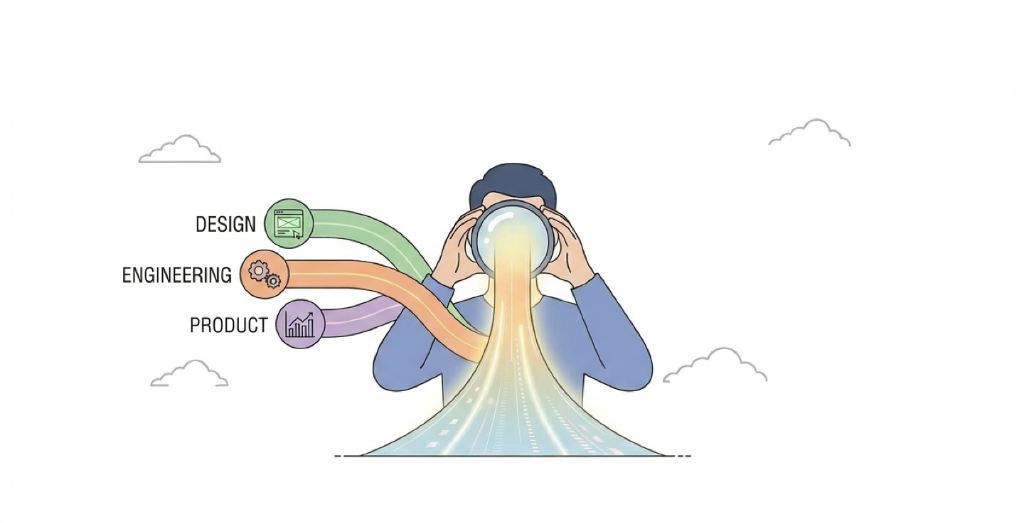
This is the shift from lanes to lenses.
A lane defines what you do: write specs, make mockups, write code. A lens defines what you see: what you notice, what you optimize for, what you catch that others miss.
A Design-oriented Builder sees the interaction, the emotional response, the moment of confusion in the flow. Their lens asks: Does this feel right? They'll catch that the error message is technically accurate but psychologically wrong. They'll notice that the loading state creates anxiety. They'll feel the friction in a transition that's 200ms too slow.
A Product-oriented Builder sees the business case, the metric, the user segment that's underserved. Their lens asks: Does this matter? They'll question whether the feature addresses the actual reason users churn. They'll notice that the checkout optimization targets a step that accounts for 3% of drop-off while ignoring the one that accounts for 40%. They'll trace a spec back to the friction that justified it—or notice that no friction justifies it at all.
A Dev-oriented Builder sees the system, the scale constraint, the edge case that breaks at 10x load. Their lens asks: Will this break? They'll catch that the agent-generated code handles the happy path but doesn't account for webhook failures. They'll notice that the database query works fine for 100 rows but will time out at 100,000. They'll see the security hole that looks like a feature.
These aren't roles. They're orientations. And the most effective builders combine more than one lens—a designer who thinks about scale, an engineer who thinks about user emotion, a PM who reads code.
From Artifacts to Outcomes
The lane model measured success by proxy: Did you finish the mocks? Is the PRD done? Is the code merged?
These artifacts were never the goal. The Figma file wasn't the product. The PRD wasn't the product. The merged PR wasn't the product. They were waypoints in a relay designed to produce a working feature—and we measured the waypoints because measuring the feature was somebody else's job.
When the relay collapses, so does the proxy. There's one question: Does it work?
| Lane Model | Lens Model |
|---|---|
| Designers produce mockups | Designers produce shipped UI |
| PMs produce specs | PMs produce shipped features |
| Engineers produce code | Engineers produce shipped systems |
| Success = artifact delivered | Success = outcome achieved |
This changes accountability. In the lane model, you could say "I delivered the spec on time" even if the feature failed. The failure was downstream—someone else's lane. In the lens model, you own the outcome. The spec, the design, and the code are all your problem, because you shipped all of them.
This is uncomfortable. It's also more honest. The artifact was always a proxy for the outcome. Now the proxy is gone, and what's left is the question that mattered all along: did you solve the user's problem?
What This Requires
The lens model doesn't work if everyone builds in isolation. Three builders shipping three different interpretations of "improve checkout UX" is worse than a relay race—at least the relay had handoff points where misalignment could surface.
Convergence requires a shared source of truth for intent. Not a shared Google Doc. Not a Slack thread. A structured artifact that everyone builds from—one that captures objectives, constraints, edge cases, and success criteria explicitly enough that three different builders with three different lenses will ship coherent software.
This is what the Intent Layer provides. It's not a handoff document between lanes. It's a shared contract that every builder—regardless of their lens—executes against. The designer reads it and optimizes for the right interaction. The PM reads it and validates the right problem. The engineer reads it and architects for the right constraints. The agent reads it and generates the right code.
Without shared intent, the lens model produces chaos. Three builders, three visions, no coherence. With shared intent, it produces something the relay race never could: a team where the person closest to the customer pain can close the loop themselves, without waiting for three handoffs and a sprint boundary.
The Uncomfortable Part
If your title is a lens and not a lane, then your value isn't in the artifact you produce. It's in the judgment you apply.
This is harder to measure, harder to defend in a performance review, and harder to hire for. "Produced 47 Figma screens this quarter" is concrete. "Caught three critical misalignments between user intent and implementation" is not—even though the second is worth more.
The transition will be messy. Titles won't change overnight. Org charts won't restructure themselves. Some people will thrive as builders; others will cling to the comfort of a lane, defined by an artifact, with clear boundaries between "my job" and "your job."
But the constraint that created the lanes is gone. The implementation bottleneck that justified the relay race has been automated. What remains is judgment—and the ability to ship.
Your title tells the world how you see. Your job is the same as everyone else's: to ship things that work.
The lanes are gone. The lenses remain.
Don't Just Write Code. Define Intent.
Turn user friction into structured Intent Specs that drive your AI agents.
Get Started for Free