
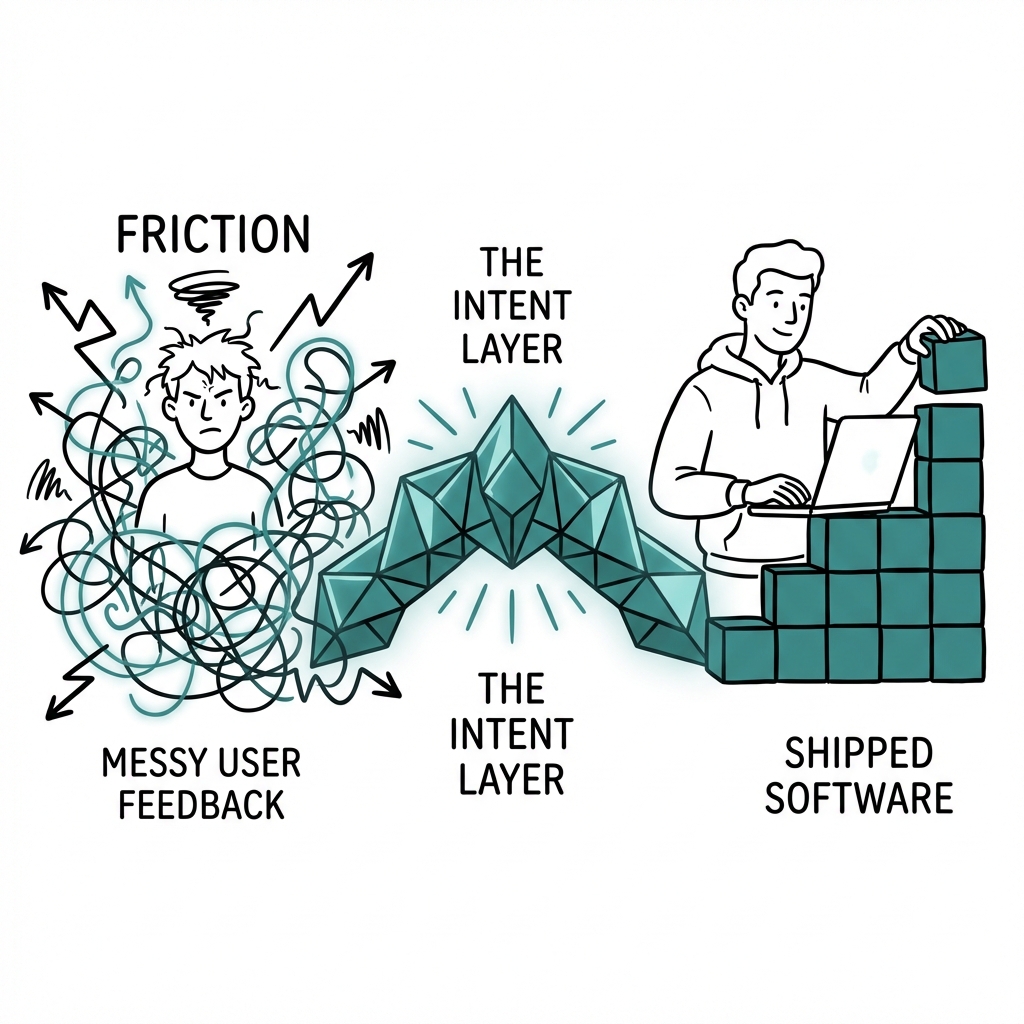
There's a silent crisis sweeping through product teams right now. Let's call it The Vibe Coding Hangover.
You've probably experienced it. Teams use AI to generate code at breakneck speed ("vibe coding"). Ship fast. Iterate faster. The velocity is intoxicating.
Then, three months later, you wake up with a massive, unmaintainable "black box" of technical debt. Why? Because prompts are not specifications.
The bottleneck has shifted. It's no longer writing code; it's defining what code to write.
The industry needs a new layer in the software stack. We call it The Intent Layer—a structured bridge between human goals and AI execution that persists alongside the code.
This isn't a prediction. It's what we've been building for the last year.
Software is Becoming a Commodity
The market is already pricing this in. Software company stocks are collapsing—not because of recession fears, but because investors realize that LLMs and AI agents are making code nearly free.
When anyone can spin up an app in a weekend, traditional moats disappear. The only sustainable advantages left are proprietary data and ecosystem lock-in. Not better code. Not faster shipping. Understanding the problem better than anyone else.
This is not philosophy. It's market reality. Software is becoming the commodity; intent is becoming the asset.
We are building the machine that mints code—not by writing it, but by defining what gets written and why.
The Vibe Coding Hangover is Real
We've all seen it. A product manager asks an AI to "make it pop" or "fix the login flow." The AI obliges. The code runs. It looks great.
But three weeks later, when you try to extend that login flow to support SSO, you realize the AI implemented a completely custom auth logic that bypasses your security middleware. There was no spec. There was no architectural "constitution." There was just a vibe.
This "code first, understand later" approach is creating billions in technical debt as teams scale AI-generated code into production.
How It Works
We've written about the Intent Layer architecture in detail. The short version: Pathmode ingests real user friction (support tickets, research, analytics), computes structured specs from that friction, and syncs those specs to the tools that execute—Linear, Jira, and AI agents like Cursor and Claude Code.
When you send a Pathmode spec to an agent, you aren't sending a prompt. You are sending an execution contract.
The Rise of the Intent Architect
The most exciting shift we're seeing is the emergence of a new role: The Intent Architect.
Instead of writing code line-by-line, this role focuses on Spec Curation—reviewing and governing what AI agents build, rather than building it themselves.
This is who we built Pathmode for.
If you are a Product Engineer or a Technical PM today, you are already doing this job. You are tired of writing tickets that get ignored. You are tired of "vibe coding" prototypes that have to be rewritten for production.
You want to stop guessing and start governing.
The Cure for the Hangover
The era of "Vibe Coding" was fun. It got us moving fast. But the hangover is here, and it hurts.
The cure isn't to stop using AI. It's to give AI a constitution—structured intent that persists alongside the code and governs what gets built.
The teams that recover fastest won't be the ones that slow down. They'll be the ones that learn to specify before they ship.
Don't Just Write Code. Define Intent.
Turn user friction into structured Intent Specs that drive your AI agents.
Get Started for Free