
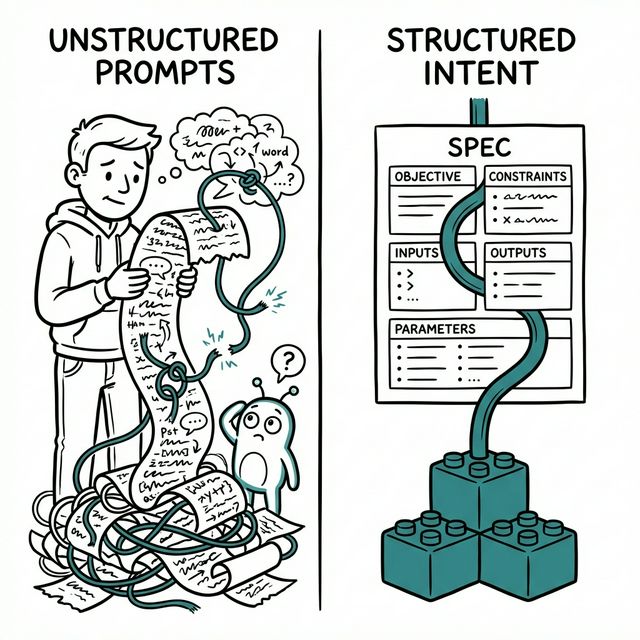
Every team I talk to has the same story. They adopted AI tools six months ago. Productivity spiked. Then it plateaued. Now they're generating more code than ever and shipping less than they'd like.
The instinct is always the same: we need better prompts. Longer prompts. More detailed prompts. Prompt templates. Prompt libraries. A Notion page called "Prompting Best Practices" that twelve people contributed to and nobody reads.
The prompts aren't the problem. What's missing is everything that should exist before you write them.
The Pattern
Watch a team build a feature with AI and you'll see the same sequence:
- PM describes a feature in a ticket or a meeting.
- Developer opens their AI tool and writes a prompt from memory of that conversation.
- Agent generates code that handles the happy path.
- Developer reviews, notices gaps, writes another prompt.
- Agent patches the gaps, introduces a new one.
- Repeat until it's "good enough" or the sprint ends.
By the time the feature ships, the developer has written fifteen prompts, each one adding context that should have existed upfront. The agent never saw the full picture—it saw a sequence of corrections.
This isn't prompt engineering. It's prompt archaeology: excavating intent one fragment at a time and hoping the pieces fit.
Why Longer Prompts Don't Fix It
The natural response is to front-load more information into the prompt. Write a paragraph instead of a sentence. Add examples. Describe edge cases. Paste in requirements.
This helps. Marginally. And it hits a ceiling fast, for three reasons:
Prompts are ephemeral. You write it, the agent consumes it, and it's gone. The next developer, the next sprint, the next agent invocation starts from zero. Institutional knowledge evaporates with every Enter key.
Prompts mix concerns. A single prompt tries to carry the objective ("build a password reset flow"), the constraints ("must use our email provider"), the edge cases ("handle expired tokens"), and the design intent ("match the existing auth UI")—all in unstructured natural language. The agent has to parse all of these from prose. It guesses which parts are requirements and which are suggestions.
Prompts lack verification criteria. A prompt tells the agent what to build. It doesn't define what "done" looks like. Without explicit success criteria, there's no way to evaluate the output except subjective review. "Does this look right?" is not the same question as "does this meet the contract?"
You can write a 500-word prompt. You still can't prompt your way to a spec.
The Gap
Between "we know what the user needs" and "the agent builds the right thing," there's a translation layer. In most teams, that layer is a person—someone who holds enough context to bridge the gap in real time.
When the builder was a human engineer, this worked. Engineers ask questions. They notice when constraints are missing. They push back when requirements are ambiguous. The conversation around the spec did the work the spec didn't.
AI agents don't have conversations. They have inputs and outputs. The quality of the output is bounded by the quality of the input—and a prompt, no matter how detailed, is a lossy compression of intent.
The gap isn't between your prompt and the model. It's between your team's understanding of the problem and what actually reaches the agent.
What Goes in the Gap
The missing layer isn't a better prompt. It's intent engineering—a structured specification that separates what a prompt mashes together:
- Objectives that define the outcome, not the feature. "Reduce failed login attempts by 40%" instead of "improve the login page."
- Constraints that are explicit, not implied. Rate limits, design system compliance, security requirements—written down, not assumed.
- Edge cases that are enumerated upfront. Not discovered in production. Not patched in sprint three.
- Success criteria that make "done" verifiable. The agent—and the reviewer—knows what the contract requires before the first line of code.
This isn't a longer prompt. It's a different artifact entirely. A prompt says "build this." An IntentSpec says "here is the contract the output must satisfy."
The difference shows up everywhere downstream. Code reviews become contract verification. QA tests against defined criteria instead of intuition. The next developer reads the spec and understands why the code exists—not just what it does.
The Real Bottleneck
Teams that struggle with AI output quality almost always diagnose it as a tooling problem or a prompting skill problem. It's neither. It's an input problem.
The model is capable. The tools are powerful. What's missing is the structured translation between what your team knows and what the agent receives. Every time a developer invents context in a prompt, they're doing work that should already be done—and doing it in a format that won't survive the session.
The spec is becoming the product. When agents execute directly from specifications, the quality of those specifications is the quality ceiling of your software. No model upgrade compensates for a missing constraint. No prompt template replaces a structured definition of success.
Your prompts aren't failing because you're bad at prompting. They're failing because prompts were never meant to carry this much weight.
The fix isn't to prompt better. It's to build the layer that makes prompts unnecessary.
Don't Just Write Code. Define Intent.
Turn user friction into structured Intent Specs that drive your AI agents.
Get Started for Free