
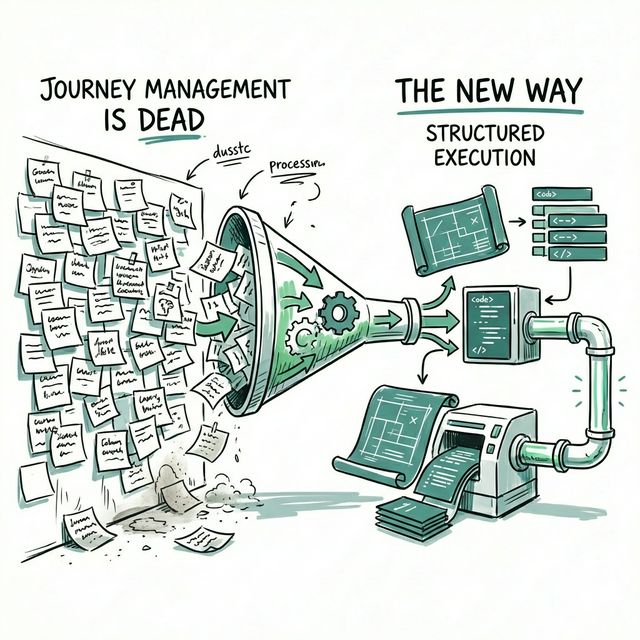
The journey management market is quietly bleeding out.
Not because customer journeys stopped mattering. Because building got faster than mapping. When an AI agent can ship a feature in an afternoon, a six-week journey mapping initiative feels like planning your route on paper while the car drives itself.
The industry's response has been predictable: abandon the map. Skip the context. Just prompt and ship.
This is a mistake. A fast, precisely wrong solution is still wrong.
The Speed Trap
Here's the seductive logic: if AI can build anything from a prompt, why spend time understanding the journey? Just describe what you want, ship it, measure it, iterate.
The problem is that speed without context creates a specific kind of failure. You ship fast, but you ship sideways. Features land that solve problems nobody has. Flows get rebuilt that were fine. Real friction—the kind buried in support tickets and session recordings—goes unaddressed because nobody looked.
Journey management tools failed because they couldn't keep up. But the answer isn't "go faster without a map." The answer is a map that moves at the same speed you do.
Why Journey Management Died
Let's be honest about what killed it.
1. The Artifact Problem. Journey maps became deliverables. PDFs. Miro boards. Figma files passed around in stakeholder meetings. The moment a journey map becomes a thing you present, it stops being a thing that drives work.
2. The Translation Gap. Even "living" journey management platforms required humans to manually translate insights into Jira tickets, PRDs, and design briefs. That translation layer was the bottleneck—and AI just made everything on the other side of the bottleneck 10x faster, making the gap unbearable.
3. The Measurement Theater. Dashboards. NPS trends. Sentiment scores. Journey management tools got very good at reporting the decline in high resolution. But reporting isn't fixing. When your competitor ships a fix while you're still updating the heatmap, the dashboard becomes a tombstone.
Teams didn't stop caring about customer experience. They stopped tolerating tools that couldn't keep up.
What Journeys Were Always Supposed to Be
Strip away the artifacts, dashboards, and stakeholder decks—and the journey is still the most powerful structure in product development.
A journey is a coordinate system. It tells you:
- Where your user is (stage and context)
- What's blocking them (friction, pain, confusion)
- What success looks like (the goal they're trying to reach)
That's not a slide deck. That's an input specification. It's exactly the structured context that AI agents need to build the right thing instead of the fast thing.
The problem was never the journey. The problem was that journey tools treated it as output—something to look at—instead of input—something to build from.
The Shift: Journey as Context Layer
At Pathmode, we don't manage journeys. We compile them.
Every journey stage becomes a structured context that feeds directly into intent specs. When a user reports friction—a support ticket, a failed flow, a rage click—it lands on the journey map not as a sticky note but as a signal with coordinates.
Those coordinates matter. They tell the system:
- This friction belongs to this stage of this journey
- 47 other users hit the same wall
- The success criteria for this step is this
- Here are the constraints and edge cases from the existing flow
From that, the system generates an Intent Spec—a structured, executable specification that an agent can pick up and build from.
No translation layer. No ticket writing. No six-week planning cycle. The journey is the spec pipeline.
The New Stack
The teams winning right now have a stack that looks like this:
| Layer | Old World | New World |
|---|---|---|
| Insight | Research repo, filed away | Friction signal, placed on journey |
| Context | Journey map, presented quarterly | Journey stage, queried in real-time |
| Specification | PRD, written manually | Intent Spec, generated from friction + context |
| Execution | Sprint, human-coded | Agent-built, human-reviewed |
The journey didn't die. It moved from Layer 0 (the thing we do before we start) to Layer 1 (the thing that runs underneath everything).
The Paradox
Journey management lost steam because building got fast. But fast building without journey context is just vibe coding with a product budget.
You'll ship more. You'll learn less. And six months in, your product will be a patchwork of well-built features that don't add up to a coherent experience—because nobody maintained the map that holds it all together.
The teams that thrive in the AI era won't be the ones that abandoned journeys. They'll be the ones that made journeys executable.
Journey management is dead. Long live journey context.
The map doesn't go on the wall anymore. It goes in the build pipeline.
Don't Just Write Code. Define Intent.
Turn user friction into structured Intent Specs that drive your AI agents.
Get Started for Free